
Root Canal or Extraction: How to Decide, and What Each Really Costs in KL
By Dr. Teo Xin Yi, BDS (Manipal)
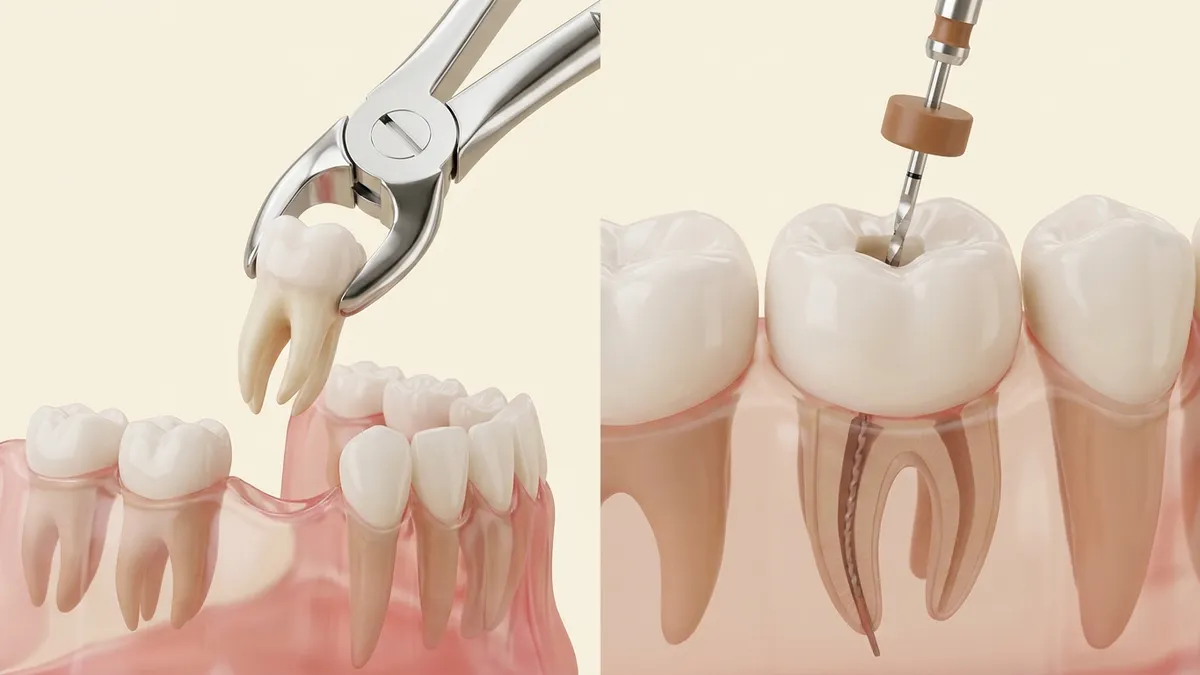
Quick answer: if the tooth can still be restored, saving it with root canal treatment is usually the more conservative and less costly path over time. Extraction is sometimes the right call, but only when the tooth is too damaged to rebuild. The deciding factor is not the upfront fee. It is what happens after the extraction, because the empty space needs to be replaced, and replacement costs more than the root canal would have.
If you are reading this with a throbbing molar at 11pm, here is the honest version of the conversation you are about to have with your dentist.
The decision you are actually making
When the nerve inside a tooth becomes infected, you have two options. Clean out the infection and keep the tooth, which is root canal treatment. Or remove the tooth entirely, which is extraction.
What most people miss is that extraction is not the end of the decision. It is the start of a second one: what goes in the gap? A dental implant, a bridge, a denture, or nothing at all. Each of those has its own cost, timeline and trade-offs. So the real comparison is not root canal versus extraction. It is root canal plus crown versus extraction plus replacement.
What each option involves
Root canal treatment removes the infected pulp from inside the tooth, cleans and disinfects the canals, then seals them. The tooth stays in your jaw with its root intact. Back teeth usually need a crown afterwards, because a tooth becomes more brittle once the pulp is removed. Most cases take one to two visits, sometimes three for a complex molar.
Extraction removes the whole tooth, root and all. The procedure itself is quick and done under local anaesthetic. Healing of the socket takes a week or two. The longer process is what follows: the jawbone in that area begins to shrink once the root is gone, and neighbouring teeth start drifting into the space over the following months.
A dental implant is the replacement option that comes closest to a natural tooth. A titanium post is placed in the jawbone, left to integrate for a few months, then fitted with a crown. It functions independently and does not rely on the teeth next to it, which is the main advantage over a bridge.
The real cost comparison in the Klang Valley
This is where the "just pull it, cheaper" logic falls apart. Here are typical private clinic ranges in the Klang Valley:
| Treatment path | Typical Klang Valley private clinic range |
|---|---|
| Root canal, front tooth | RM800 to RM1,200 |
| Root canal, premolar | RM1,000 to RM1,500 |
| Root canal, molar | RM1,500 to RM2,200 |
| Crown after root canal | RM1,000 to RM2,500 |
| Total: save the tooth | roughly RM1,800 to RM4,700 |
| Simple extraction | RM150 to RM400 |
| Single implant with crown | RM6,000 to RM10,000 |
| Total: extract and replace | roughly RM6,200 to RM10,400 |
A few things worth knowing about these numbers.
Root canal fees vary mainly by which tooth is involved. A front tooth has one canal. A molar can have three or four, which means more time in the chair and a higher fee. This is why a clinic cannot quote you an exact figure over WhatsApp without knowing which tooth it is. Crown fees vary with the material chosen. And one useful nuance: front teeth with enough structure remaining can sometimes be restored with a filling rather than a crown, which brings the total down further. Your dentist will confirm which restoration your tooth needs after assessing it.
Government dental clinics offer root canal treatment at subsidised rates, typically RM80 to RM250, but the route in works differently from private care. You would usually start at a Klinik Pergigian, and root canal cases are often referred onwards to a government specialist unit. These units generally take referral cases only, and usually accept those assessed as difficult. Waiting times for non-urgent cases can stretch six to twelve months, and crowns are generally not provided, so the final restoration would still be done at a private clinic. If your tooth is actively infected, waiting months is not a neutral choice. Infections spread.
At Heal Dental, single dental implants start from RM6,000, and 0% instalment plans apply to treatments from RM6,000.
When saving the tooth makes sense
A root canal is worth doing when there is enough healthy tooth structure left to rebuild. In practice, that usually means the decay or fracture has reached the nerve but the walls of the tooth are still standing, or can be restored with a post and crown.
Keeping your natural tooth matters more than most people realise. Your own root preserves the jawbone around it. The tooth keeps its natural position in your bite. And nothing manufactured matches the way a natural root transmits chewing force. A well done root canal with a crown can keep a tooth functioning for many years, though longevity depends on the tooth, the restoration and how well it is maintained.
When extraction is the better call
Sometimes the honest answer is that the tooth cannot be saved, and doing a root canal anyway would waste your money. Common situations include a fracture that runs down into the root, decay that has destroyed the tooth below the gumline, advanced gum disease where the bone supporting the tooth is already lost, or a previous root canal that has failed and retreatment is unlikely to succeed.
In these cases, extraction followed by a planned replacement gives a more predictable result than trying to rescue a tooth with a poor prognosis. The key word is planned. Extracting with a clear replacement plan is a legitimate treatment decision. Extracting to avoid a decision is where problems start.
What happens if you extract and leave the gap
This is the part of the conversation that often gets skipped, so let us not skip it.
Within the first year after an extraction, the jawbone in that area loses a significant portion of its width, because bone needs the stimulation of a root to maintain itself. The teeth on either side begin tilting into the space. The opposing tooth, with nothing to bite against, can start over-erupting out of its socket. Over a few years, a single missing molar can quietly reorganise your whole bite.
There is also a practical cost. The longer a gap is left, the more bone shrinks, and the more likely an implant later will need bone grafting first, which adds both cost and treatment time. If you are leaning towards extraction, it is worth deciding on the replacement at the same time, not years later.
Pain, visits and recovery, compared honestly
The fear of root canals is mostly inherited from a previous generation of dentistry. With modern local anaesthetic and rotary instruments, the procedure itself usually feels similar to having a large filling done. Most of the pain people associate with root canals is actually the toothache before treatment, not the treatment itself. Some tenderness for a few days afterwards is normal and manageable with ordinary painkillers.
Extraction is also done under local anaesthetic and is not painful during the procedure. The recovery is where the two differ. An extraction socket takes longer to settle, comes with eating restrictions for the first days, and carries a small risk of dry socket. A root canal generally lets you get back to normal faster.
Visit-wise, a root canal takes one to three appointments, not including a crown fitting. An implant journey runs three to six months from placement to final crown, because the bone needs time to integrate around the post.
How to decide: three questions
You cannot make this decision from a blog post, and neither can a dentist over WhatsApp. It takes an examination and an X-ray, because the answer lives below the gumline where nobody can see it. But these three questions frame the assessment:
How much solid tooth structure is left? If the tooth can be rebuilt with a crown, saving it is usually on the table. If the damage extends below the gum or through the root, it usually is not.
What does the bone around the tooth look like? A tooth with healthy supporting bone is worth saving. A tooth that is loose from bone loss is a poor investment regardless of how good the root canal is.
What is your plan for the space if you extract? If the answer is an implant, compare the full costs and timelines side by side. If the answer is nothing, re-read the section above on what gaps do to your bite.
Talk it through before deciding
If you are weighing this decision right now, the useful next step is an examination and an X-ray, so you know whether your tooth is actually saveable before committing either way.
Heal Dental Clinic is located at Aked Esplanad, Bukit Jalil, and serves patients from Bukit Jalil, Sri Petaling, OUG and Kuchai Lama. Consultations are available in English, Mandarin, Cantonese and Bahasa Malaysia.
WhatsApp us with which tooth is troubling you and when the pain started, and we will advise on the next step. Open Monday to Saturday 9am to 7pm and Sunday 10am to 5pm.
Frequently asked questions
Is a root canal painful?
The procedure is done under local anaesthetic and most patients find it comparable to having a deep filling. The severe pain people associate with root canals is usually the infection before treatment. Treatment is what removes that pain.
How much does a root canal cost in KL?
In private Klang Valley clinics, expect roughly RM800 to RM2,200 per tooth depending on which tooth is involved, with molars at the higher end because they have more canals. A crown afterwards typically adds RM1,000 to RM2,500 depending on the material. Government clinics charge subsidised rates, but root canal cases usually go through a Klinik Pergigian referral, involve longer waits and generally do not include crowns.
Is it cheaper to just extract the tooth?
Only if you never replace it, and leaving a gap creates its own problems. Once you include a replacement implant, the extraction route typically costs more than saving the tooth with a root canal and crown.
How many visits does a root canal take?
Usually one to two visits, sometimes three for complex molars. The crown fitting is a separate appointment afterwards.
Can I leave the gap after an extraction?
You can, but the jawbone in that area shrinks over time, neighbouring teeth drift into the space, and the opposing tooth can over-erupt. Delaying replacement also increases the chance that bone grafting will be needed before an implant later.
How long does a root canal treated tooth last?
With a crown and good oral hygiene, many root canal treated teeth remain functional for well over a decade. Longevity depends on the tooth involved, the quality of the final restoration and regular dental care.