Seeing Blood When You Brush? What Your Bleeding Gums Are Telling You
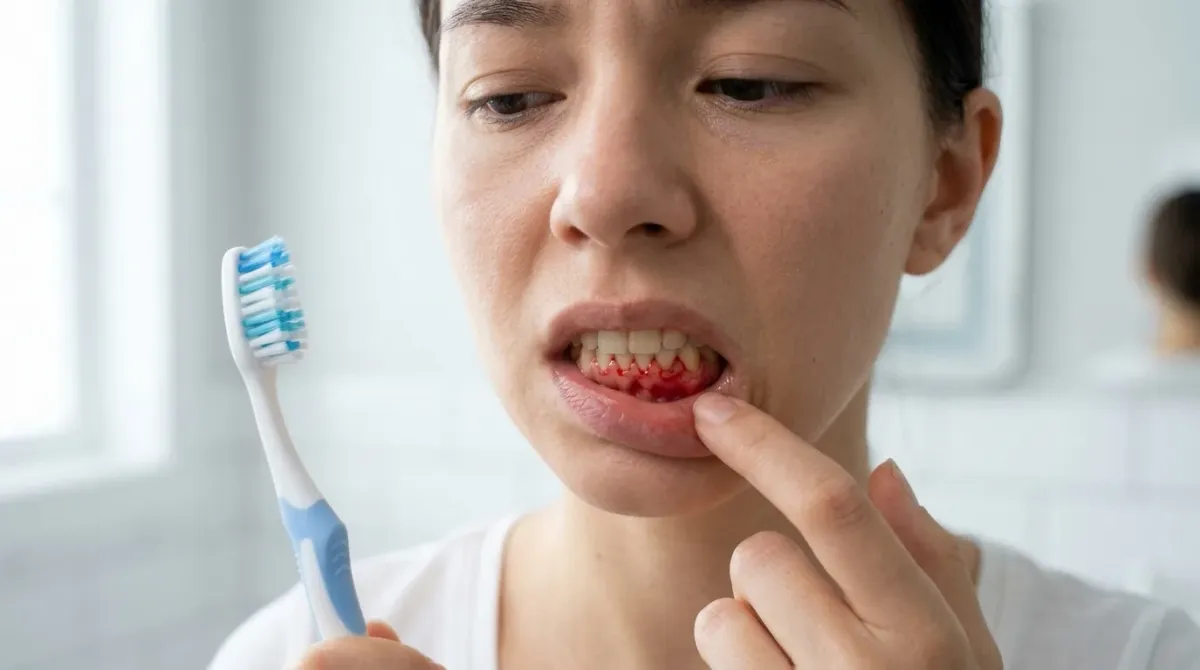
Bleeding gums when you brush are common, but they are not normal. Usually the cause is plaque sitting along the gumline, which inflames the gums. That early stage is gingivitis, and it can settle once the plaque is properly cleaned away. Left alone, it can progress to periodontitis, which slowly breaks down the bone that holds your teeth in. In Malay, you'll hear it called gusi berdarah.
Here's why it matters. Malaysia's last national adult oral health survey, NOHSA 2020, examined 16,734 adults. Only 5.1% of those with natural teeth had healthy gums. Picture 100 Malaysian adults with their own teeth: only about 5 of them would have healthy gums. Periodontitis showed up in 38.2%. Yet 53.9% of adults rated their own oral health as good or excellent.
In other words, plenty of people with gum disease think their mouth is fine. If you've been spitting pink into the sink and hoping it stops, this is what your gums are trying to tell you, and what to do about it this week.
Why do my gums bleed when I brush?
Plaque is a soft, sticky film of bacteria that forms on your teeth every day. When it sits along the gumline, your gums react to it. They swell, turn redder and become fragile, so the light pressure of a toothbrush or floss is enough to make them bleed. The brush isn't causing the problem. It's revealing it.
We've known this since a classic experiment in 1965. Healthy volunteers stopped cleaning their teeth, and every one of them developed gingivitis within 10 to 21 days. When they started cleaning properly again, their gums were back to health in about a week.
That's the good news hiding in bleeding gums. At the gingivitis stage, nothing has been permanently lost. The catch is that gingivitis is usually painless, which is exactly why so many people live with it for years without doing anything.
Less often, bleeding comes from brushing too hard, from hormonal changes in pregnancy, or from blood-thinning medicines that make any bleeding heavier. If you're pregnant, our scaling and polishing guide covers when a clean is best timed.
Is it just because I'm heaty?
You may have been told that bleeding gums mean you're heaty, and that herbal tea or vitamin C will cool things down. It's a well-meant answer, but heatiness isn't a cause recognised in dental research, and herbal tea can't lift plaque off your teeth. If plaque is the cause, the bleeding carries on.
Vitamin C is a fairer question. A 2021 review of 15 clinical trials found that low vitamin C levels were linked with gums that bleed more easily, and that topping up vitamin C reduced bleeding in people whose levels were low. It didn't clearly help people whose levels were already normal.
So if your diet is light on fruit and vegetables, it's worth fixing for its own sake. But for most people, gums that bleed because of plaque need cleaning, not a supplement.
Gingivitis or periodontitis: which one is it?
Both can bleed, and you can't reliably tell them apart in the mirror. The difference is what's happening below the gumline.
Gingivitis is inflammation of the gum only. Nothing has been lost yet, and the gums can return to full health once the plaque is under control.
Periodontitis is the next stage. The gum starts to come away from the tooth, forming a pocket where plaque and tartar collect out of reach of your brush. Over time, the bone around the tooth is lost. That bone doesn't grow back on its own, so treatment aims to stop the disease and keep it stable rather than undo it.
Signs that point towards periodontitis include gums that have shrunk back, new gaps between teeth, teeth that feel loose or have shifted, bad breath that brushing doesn't fix, and swelling or pus near a tooth. In NOHSA 2020, 14.5% of Malaysian adults already had deep gum pockets, the more advanced end of the disease.
Not sure which one you have? That's normal. Telling them apart needs a dentist to measure the gums, which I explain further down.
Your gums and your blood sugar: the link Malaysians should know
This is the part of gum health I wish more patients knew about. People with diabetes are more likely to develop periodontitis, and periodontitis can make blood sugar harder to control. Each one feeds the other.
That matters a lot in Malaysia. Malaysia's National Health and Morbidity Survey 2023 found diabetes in 15.6% of adults, about 3.6 million people. Two in five of them didn't know they had it. Among adults aged 18 to 29 with diabetes, 84% were unaware.
The encouraging part: treating the gums seems to help the blood sugar side too. A 2022 Cochrane review pooled 30 trials in people with both diabetes and periodontitis. Gum treatment lowered HbA1c, the long-term blood sugar measure, by an average of 0.43 percentage points three to four months later, compared with no treatment or usual care. It's a modest change and it doesn't replace diabetes care, but it's a real one.
What this means for you. If you have diabetes, tell your dentist and keep your gum checks regular. If your gums are in poor shape and you've never been screened for diabetes, mention it to your doctor. The same survey found two in five adults hadn't been screened for diabetes, blood pressure or cholesterol in the past year, and the top reason given was that they felt healthy. Gums work the same way.
Smoke? Your gums may be hiding it
If you smoke, gums that don't bleed aren't necessarily good news. Smoking dampens the way gums respond to plaque, so they bleed less even when disease is there. In one study of people with periodontitis, smokers had more plaque than non-smokers but bled at fewer sites, 27% against 40%. A study of 1,911 adults in Norway found the effect grew stronger the more people had smoked.
Smoking is also one of the biggest behavioural risk factors for periodontitis getting worse. So if you smoke, don't wait for bleeding as your warning sign. Regular gum checks are the warning sign.
What to do at home, starting tonight
Keep brushing, even if you see blood. Stopping lets more plaque build up, which is exactly how gingivitis starts. Brush twice a day with a fluoride toothpaste, gently, with a soft brush. Spit afterwards, but don't rinse with water, so the fluoride stays on your teeth.
Clean between your teeth once a day. Your brush can't reach the gaps between teeth, and that's where gum disease tends to start. A 2019 Cochrane review found that floss or interdental brushes, used alongside brushing, may reduce gingivitis more than brushing alone, and that interdental brushes may do slightly better than floss. The evidence is low certainty, but it points one way. Expect some bleeding for the first few days. That's the inflamed gum, not damage.
Consider an electric toothbrush. A Cochrane review of 56 trials found that people using powered brushes had 6% less gingivitis than manual brush users at one to three months, and 11% less after three months. Helpful, not magic. A manual brush used well still does the job.
Treat mouthwash as an extra, not a fix. It doesn't replace brushing and cleaning between teeth. If you use one, don't use it straight after brushing, or you'll wash the fluoride away.
Give it two weeks. In the 1965 experiment, gums recovered in about a week once cleaning restarted. If yours are still bleeding after two weeks of careful cleaning, something is getting in the way. Often that's tartar, which no toothbrush can remove. In NOHSA 2020, tartar was the main gum finding in about half of Malaysian adults (51.5%).
When to see a dentist sooner, or a doctor
Don't wait the two weeks. Book a dental appointment soon if your gums are very sore and swollen, a tooth feels loose, there's swelling or pus near a tooth, or you have ulcers, red patches or a lump in your mouth. For pain or swelling that can't wait, see our emergency dental care page.
See a doctor as well if your gums bleed without you brushing, the bleeding is heavy or slow to stop, or it comes with easy bruising, frequent nosebleeds, unusual tiredness, fever or repeated infections. Together, these can point to a problem with blood clotting, and a simple full blood count is the usual first test. Most bleeding gums are caused by gum disease, not anything like this. These signs are still worth taking seriously.
If you take blood thinners and your gums are bleeding more than usual, tell both your dentist and your doctor. Don't stop the medicine on your own.
What happens at a gum check with us
I start by looking at your gums and where plaque and tartar are building up. Then I use a fine measuring probe to check the small space between each tooth and its gum. Healthy gums have a shallow space. Deeper readings, and spots that bleed when measured, show where disease is active. If the readings suggest bone loss, an X-ray shows how much support is left around the teeth.
What comes next depends on what we find. Gingivitis usually needs scaling and polishing and a few changes at home. Periodontitis needs a deeper clean below the gumline and closer follow-up, often every three to four months rather than six. Either way, you'll know what we found and what the treatment involves before anything starts.
Wondering what the clean itself feels like, or why some people notice gaps afterwards? Our scaling and polishing guide answers both.
Get your gums checked in Bukit Jalil
If your gums have been bleeding for more than a couple of weeks, or you can't remember your last check, it's worth a look. Catching gum disease at the gingivitis stage keeps your options simple.
Heal Dental Clinic is at 10-7 (Ground Floor), Jalan Jalil Perkasa 15, Aked Esplanad, Bukit Jalil. We're open seven days a week: Monday to Saturday 9am to 7pm, and Sunday 10am to 5pm. Patients come to us from Sri Petaling, OUG and Kuchai Lama, and we're a PMCare panel clinic.
WhatsApp us on +6013-238 3177 and tell us your gums have been bleeding. If you have diabetes, smoke or are pregnant, mention that too, so we can plan your visit around it.
Frequently asked questions
Is it normal for gums to bleed when I brush?
It's common, but it isn't normal. Healthy gums don't usually bleed with gentle brushing. Bleeding is most often a sign of gingivitis, the early, reversible stage of gum disease.
Should I stop brushing or flossing if my gums bleed?
No. Stopping lets plaque build up and makes the inflammation worse. Keep brushing gently twice a day and clean between your teeth daily. The bleeding usually eases as the gums settle.
Can bleeding gums heal on their own?
Gingivitis can settle with good daily cleaning, often within a week or two. Tartar can't be brushed off and needs a professional clean. Periodontitis won't reverse on its own and needs treatment to stop it progressing.
Are bleeding gums a sign of diabetes?
Not on their own. But diabetes and gum disease are closely linked, and two in five Malaysian adults with diabetes don't know they have it. If your gums are in poor shape and you've never been screened, ask your doctor.
Why don't my gums bleed if my dentist says I have gum disease?
Smoking is a common reason. It dampens the gums' bleeding response, so disease can be present without much bleeding. That's why regular gum checks matter more for smokers, not less.
Is vitamin C enough to stop bleeding gums?
Only if low vitamin C is part of the cause. Research shows it helps people whose levels are low, not those whose levels are normal. For most people, plaque is the cause, and cleaning is the fix.
Related services
References
- Ministry of Health Malaysia. NHMS 2020: National Oral Health Survey of Adults (NOHSA 2020) fact sheet.
- CodeBlue. Over two million adults in Malaysia live with three NCDs: NHMS 2023. 28 May 2024.
- Simpson TC et al. Treatment of periodontitis for glycaemic control in people with diabetes mellitus. Cochrane Database of Systematic Reviews, 2022.
- Worthington HV et al. Home use of interdental cleaning devices, in addition to toothbrushing, for preventing and controlling periodontal diseases and dental caries. Cochrane Database of Systematic Reviews, 2019.
- Yaacob M et al. Powered versus manual toothbrushing for oral health. Cochrane Database of Systematic Reviews, 2014.
- Löe H, Theilade E, Jensen SB. Experimental gingivitis in man. Journal of Periodontology, 1965. Summarised in Lang NP, Schätzle MA, Löe H. Gingivitis as a risk factor in periodontal disease. Journal of Clinical Periodontology, 2009.
- Trombelli L et al. Plaque-induced gingivitis: case definition and diagnostic considerations. Journal of Clinical Periodontology, 2018.
- FDI World Dental Federation. Periodontal diseases fact sheet. April 2025.
- Hujoel PP et al. Bleeding tendency and ascorbic acid requirements: systematic review and meta-analysis of clinical trials. Nutrition Reviews, 2021.
- Influence of cigarette smoking on the occurrence of gingival bleeding. Acta Odontologica Scandinavica, 1985.
- Holde GE et al. To what extent does smoking affect gingival bleeding response to supragingival plaque? Journal of Periodontal Research, 2019.
- Smokers and never-smokers: gingival bleeding index and bleeding on probing. Revista de Odontologia da UNESP.
- NHS. Gum disease. Reviewed 20 April 2026.
- Leukaemia UK. Unexplained bruising or bleeding: could it be a sign of leukaemia?